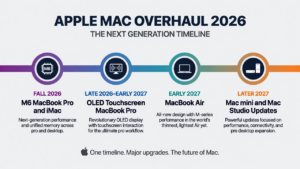

We’ve all seen the cycle: you click “buy” on a flagship Mac, and three months later, the roadmap shifts. But right now, the stakes are higher because we aren’t just looking at incremental clock-speed bumps. Between the sudden hunger for local AI applications like OpenClaw and the looming transition to TSMC’s 2nm Gaffit technology, the hardware landscape is in a state of flux, thus the leaked Apple Macs.

The reality is that Apple’s supply chain is currently gasping for air. If you’ve tried to find a base M4 Mac Mini recently and noticed they’re vanishing, you’re seeing the “AI tax” in real-time. We’re diving into the eight leaked Mac models that will define the next two years, helping you decide if you should grab what’s on the shelf or hold out for the M6 revolution.
Table of Contents
The leaked Apple Mac M5 Generation: AI Demand Meets Supply Constraints
The current M4 generation is a victim of its own success. Our data shows that Mac Mini sales are at an all-time high because tech-savvy users are utilising them as dedicated, affordable AI nodes. This popularity has caused a ripple effect throughout the 2026 roadmap.
M5 Mac Mini: The “Delayed” Successor
Originally estimated to launch between now and WWDC on June 8th, the M5 Mac Mini is now facing a likely pushback to late summer or fall 2026. During recent earnings calls, Apple hinted at significant supply constraints for the Mini and Mac Studio lines.
Interestingly, Apple recently discontinued the base 256GB storage model, effectively forcing a $200 “AI tax” on users by making the 512GB model the new entry point. If you’re waiting for the M5, expect the same chassis but with a chip better optimised for thermal sustained loads.

M5 Max and M5 Ultra Mac Studio
Per recent statements from Mark Gurman, do not look for the M5 Mac Studio at WWDC. A fall 2026 release is much more likely. From Apple’s perspective, there is no rush—the current M4 Max/Ultra models are selling incredibly fast. These machines have become the gold standard for local AI workloads due to their massive unified memory support, with professional users reportedly spending thousands of dollars on single machines to keep their data off the cloud.

The Technical Leap: 2nm “Gaffit” Technology vs. 3nm
The most significant leak in the current cycle involves the transition from TSMC’s 3nm process to the brand-new 2nm Gaffit chip technology. This isn’t just a marketing buzzword; it represents a fundamental shift in transistor design.
Why “Gaffit” Matters
While the M4 and M5 series rely on refined 3nm processes, the M6 series will move to the 2nm node. The “Gaffit” designation refers to the specific implementation of Gate-All-Around (GAA) nanosheet transistors.
| Feature | 3nm (N3E/M5) | 2nm Gaffit (N2/M6) |
| Transistor Architecture | FinFET | GAA Nanosheet |
| Logic Density | Base | ~1.15x Increase |
| Power Efficiency | Standard | 25–30% Improvement |
| Performance Gain | Incremental | 10–15% Clock Speed Boost |
By surrounding the channel with the gate on all four sides, Gaffit technology drastically reduces “leakage,” allowing the upcoming M6 Pro and M6 Max chips to run significantly cooler while drawing less power. However, this tech is also the reason for upcoming delays. The iPhone 18 Ultra is designed to use this exact same chip supply, and leaks suggest Apple simply won’t have enough 2nm capacity to launch both the iPhones and the redesigned MacBook Pros in the fall of 2026.
The M6 Revolution: Tandem OLED and the MacBook Pro Redesign
If you can hold out until the spring of 2027, the M6 MacBook Pro is shaping up to be the first “must-buy” redesign in years.
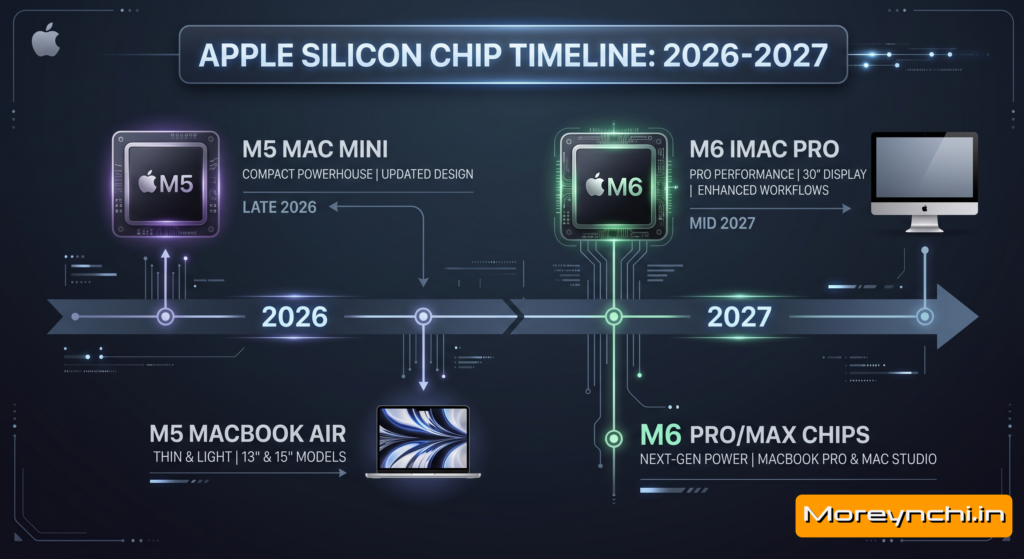
The M6 Pro and M6 Max (Spring 2027)
This model is expected to sit above the current lineup as a premium tier. It will reportedly feature Tandem OLED displays, the same tech currently used in the high-end iPad Pros, offering incredible peak brightness and deep blacks without the blooming of Mini-LED. Because of the 2nm Gaffit chip shortages mentioned above, expect this launch to be pushed out of the traditional fall window and into early 2027.
The Return of the iMac Pro
For years, the iMac Pro has been a ghost. However, leaks reveal that Apple has been actively stress-testing M5 Max chips within an iMac chassis to refine the cooling system. The final product is rumoured to be the M6 Max iMac Pro, featuring a design language inspired by the Studio Display—ultra-thin, professional, and featuring a 27-inch or 32-inch panel. We expect a potential launch in the fall of 2027.

Bridging the Gap: MacBook Neo2 and MacBook Air
Not everyone needs a 2nm powerhouse. For the entry-level and mid-range, Apple is diversifying its silicon strategy.
MacBook Neo2: This model is actively in development and will likely keep the existing chassis but swap the heart of the machine for an A19 Pro chip. By using “binned” or flawed chips from the iPhone 17 Pro production line, Apple avoids the supply shortages affecting the M-series. To address AI needs, the Neo2 is rumoured to feature 12GB of RAM as the new standard.
M6 MacBook Air: Expected in Spring 2027. The current M5 Air is currently viewed as an “awkward middle child,” but the M6 version will gain efficiency from binned-down 2nm chips, providing the best battery life in the history of the Mac lineup.
Also Read,
Apple WWDC 2026: 5 Shocking Leaks Every Indian Tech Fan Needs to Know
Leveraging AI Today: The Software Side
While we wait for M6 hardware to solve memory bottlenecks, software optimisation has become the priority. For our internal workflows, we’ve been using Abacus AI to bridge the gap. It allows us to toggle between models like GPT-5.4, Gemini 3.1, and Claude 4.6 with a single click.
Tools like these feature “Route LLM,” which automatically selects the best model for a specific task. This is critical for users on current M4 or M5 hardware, as it optimises GPU cycles and manages local memory more effectively than running unoptimized local models.
In Summary
The next 18 months of Apple silicon will be defined by “The Great AI Split.” If you are a professional whose livelihood depends on local LLMs or massive video renders, the M4 or M5 Mac Studio is a safe buy today—the memory bandwidth is already there, and the M6 delays mean you won’t be “obsolete” for a long time.
However, if you are looking for a laptop, we recommend waiting. The jump to the M6 MacBook Pro with its 2nm Gaffit architecture and Tandem OLED display represents a true generational shift that the incremental M5 update simply won’t match.
Which leak has you most excited? Are you holding out for the return of the iMac Pro, or is the 12GB RAM standard on the MacBook Neo2 the upgrade you’ve actually been waiting for? Let us know your thoughts in the comments below!
FAQs
1. When is the M5 Mac Mini coming out? While initially expected earlier in the year, the M5 Mac Mini release date has likely been pushed back to late summer or fall of 2026. This delay is largely due to ongoing supply chain constraints and unexpectedly high demand for the current M4 generation, which tech enthusiasts are rapidly buying up to run local AI applications like OpenClaw.
2. Why is the M5 Max and M5 Ultra Mac Studio delayed? According to recent leaks, you shouldn’t expect the M5 Mac Studio at WWDC. A fall 2026 (potentially October) release is more likely. The current Mac Studio models are acting as highly popular, dedicated local AI workstations. Because they are selling so well and the industry is facing high-performance memory shortages, Apple is prioritising current production over rushing the M5 refresh.
3. What is a 2nm “Gaffit” chip, and which Mac will get it first? The 2nm “Gaffit” chip refers to a next-generation manufacturing process by TSMC utilising Gate-All-Around (GAA) nanosheet transistors. It promises significant boosts in processing power and power efficiency over the current 3nm chips. The completely redesigned M6 Pro and M6 Max MacBook Pros (expected in Spring 2027) will be the first Macs to feature this technology, sharing the supply with the iPhone 18 Ultra.
4. Will the iMac Pro ever return? Yes, rumours strongly suggest the iMac Pro is finally making a comeback. Leaks indicate that Apple is currently stress-testing M5 Max chips within iMac enclosures to refine the cooling system. However, the final product is expected to be an M6 Max iMac Pro housed in a sleek, thin chassis similar to the Studio Display, with a targeted launch in the fall of 2027.
5. What are the rumoured specs for the MacBook Neo2? To address current AI memory bottlenecks, the upcoming MacBook Neo2 is rumoured to feature a 12GB RAM standard. Instead of a traditional M-series chip, it is expected to utilise a binned-down A19 Pro chip (the same architecture intended for the iPhone 17 Pro). Because it uses these specific chips, it is not expected to face the same supply shortages as the M-series lineup, with a launch targeted for spring or summer 2027.